Navigating the Future of Indio-Afghan Relations
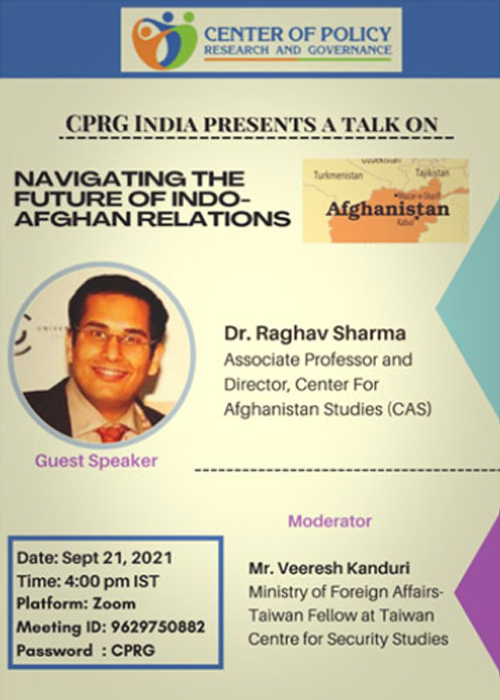
The evolving situation in Afghanistan remains central to current geopolitical discourse. The withdrawal of the United States after two decades and the subsequent return of a hardline regime have significantly altered the regional balance of power. These developments compel a reassessment of India’s foreign policy approach toward Afghanistan and the broader Asian landscape.
In this session held on Sept 21, 2021, Dr. Raghav Sharma, an expert on South and Central Asian geopolitics, examined India’s strategic options in the wake of the Taliban’s resurgence. His analysis focused on the recalibration of Indo-Afghan relations, the potential diplomatic and security challenges, and how India might position itself more assertively within the shifting contours of Asian geopolitics.
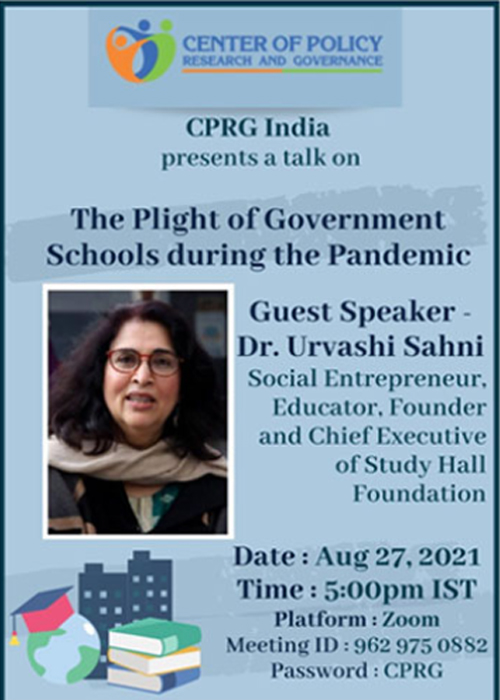
The Plight of Government Schools During the Pandemic
The COVID-19 pandemic disrupted nearly every aspect of life, and the education sector was among the hardest hit. Prolonged school closures, especially in government-run institutions, exposed deep structural inequalities in access to learning. While digital education emerged as a temporary solution, it remained inaccessible to large segments of the population, widening existing gaps.
In this webinar held on Aug 27, 2021, Dr. Urvashi Sahni provided a detailed assessment of the pandemic’s impact on India’s education system, with a particular focus on government schools. Her talk addressed the limitations of digital learning in low-resource settings and explored the long-term implications of these disruptions on educational equity and public policy.
India’s Vaccine Diplomacy in COVID-19: Impact and Prospects
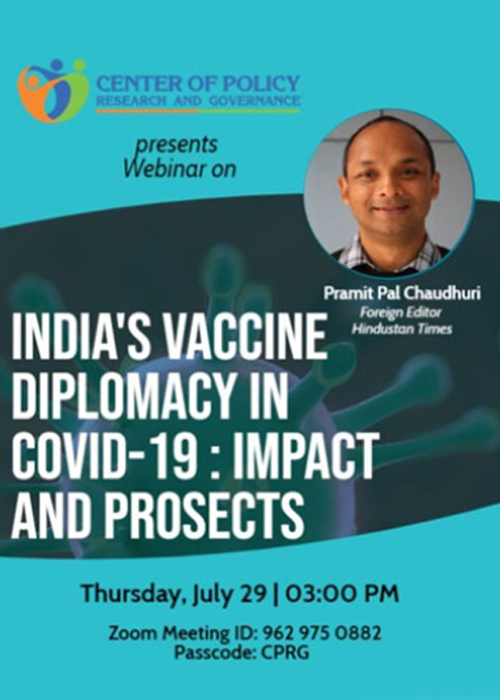
As part of its response to the global COVID-19 crisis, India launched the Vaccine Maitri Programme in January 2021, an initiative that, despite its limited duration, reinforced India’s strategic commitment to global health equity. In a period marked by rising vaccine nationalism, India’s outreach signaled a distinct approach rooted in humanitarianism and regional solidarity, particularly across South Asia.
This session held on July 29, 2021, led by Mr. Pritam Pal Chaudhary, Foreign Editor at Hindustan Times, examined the geopolitical and diplomatic dimensions of India’s vaccine initiative. Mr. Chaudhary offered critical insights into how India’s pandemic-era diplomacy shaped its international standing and what it suggests about the country’s evolving foreign policy in times of global crisis.
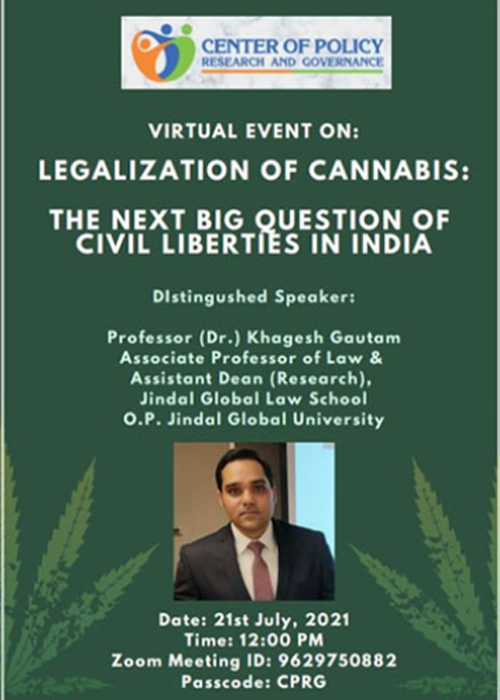
Legalisation of Cannabis: The Next Big Question of Civil Liberties in India.
On July 21, 2021, CPRG hosted a virtual seminar on the legal and civil liberties dimensions of cannabis regulation in India. The session featured Prof. Khagesh Gautam, who spoke on the theme of his forthcoming book, Legalisation of Cannabis: The Next Big Question of Civil Liberties in India. His talk explored the constitutional and policy questions surrounding cannabis legalisation and its place within India’s evolving rights discourse.
Future of Technology, Innovation and Entrepreneurship
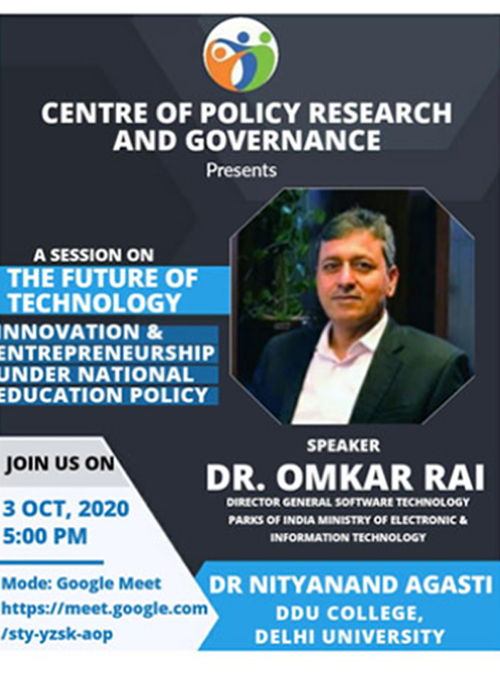
On October 3, 2020, CPRG hosted a session focused on the evolving role of technology and innovation in shaping India’s educational and entrepreneurial landscape under the National Education Policy (NEP). Dr. Omkar Rai shared insights on how NEP 2020 can act as a catalyst for fostering innovation, supporting tech-driven entrepreneurship, and aligning education with emerging industry needs.
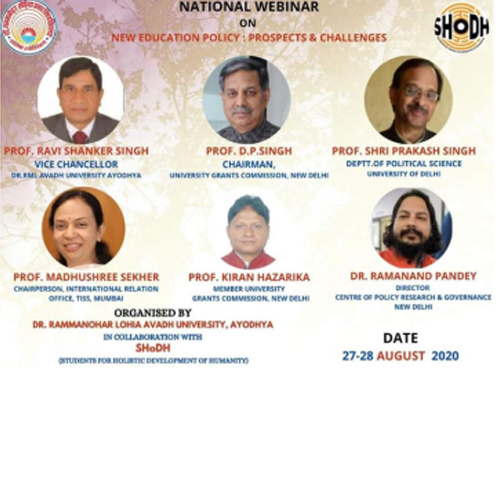
National Education Policy : Prospects and Challenges
Speaker: Dr. Raghav Sharma, Director, Centre for Afghanistan Studies
Speaker: Dr. Ramanand Pandey, Director, CPRG
On August 28, 2020, Dr. Ramanand Pandey, Director at the Centre of Policy Research and Governance (CPRG), spoke at a national webinar on the National Education Policy (NEP) 2020, hosted by Dr. Ram Manohar Lohia Avadh University, Ayodhya, in collaboration with ShoDH.
Drawing from his experience as a consultant with the Ministry of Human Resource Development (MHRD), Dr. Ramanand provided firsthand insights into the policy-making process behind NEP 2020. His remarks focused on both the prospects and challenges of implementation, particularly within the context of institutional reform and inclusive education.